
What Upfitting Is, Who Does It, and What It Pays
What Upfitting Is
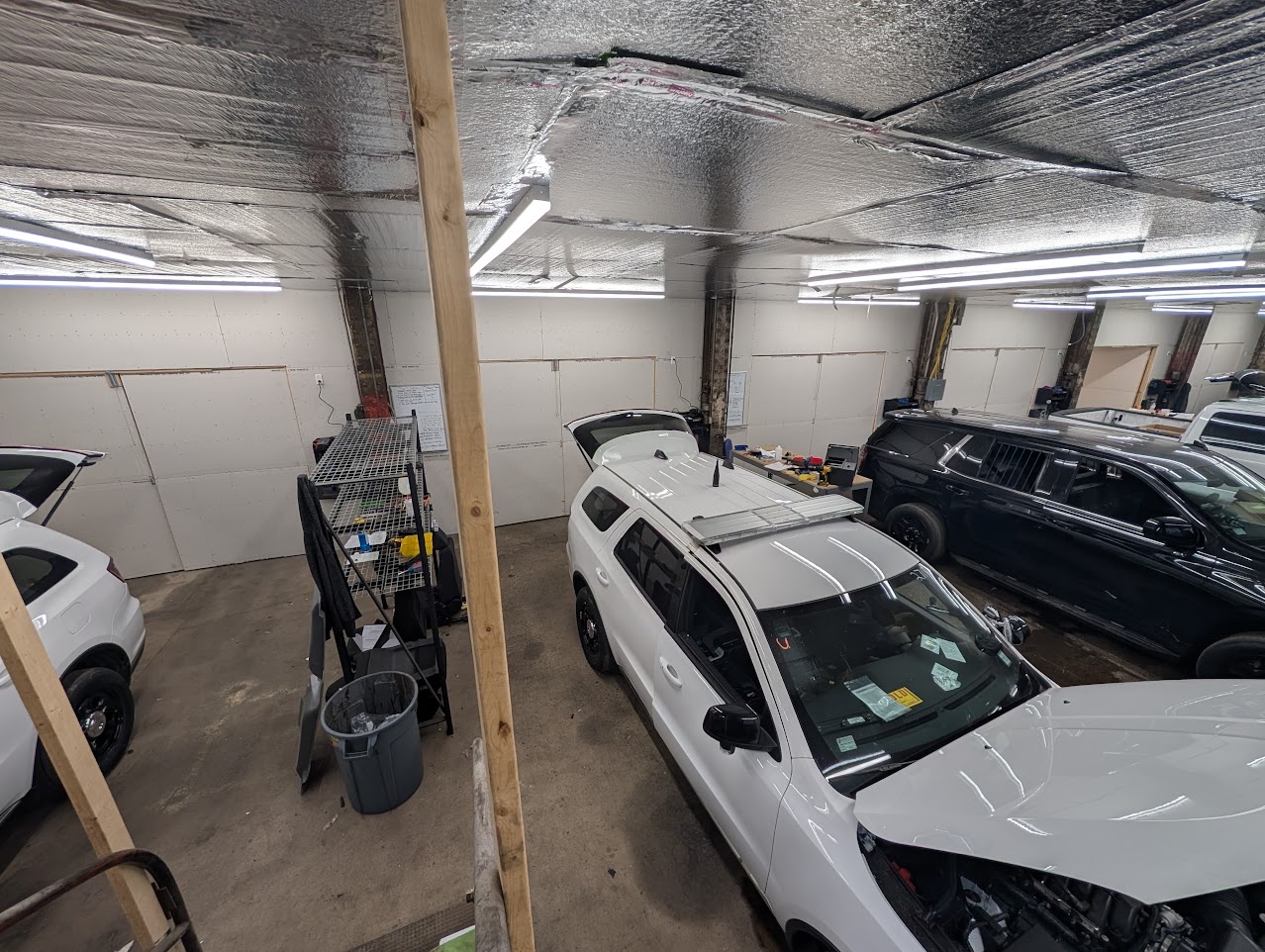
The factory builds a sturdy SUV with a big alternator and a lot of empty holes. Everything that makes it a police car, an ambulance or a plow truck gets added afterward by someone whose name is not on the badge or the grille.
The job, in one sentence
Upfitting — installing, wiring, programming, testing and documenting the equipment that turns a stock vehicle into a working emergency or fleet vehicle.
An upfitter is not a mechanic. A mechanic repairs what the factory installed. An upfitter adds what the factory deliberately left out, then takes responsibility for how it behaves for the next eight years. The trade name is Emergency Vehicle Technician, or EVT. On a shop floor you will also hear "installer," "12-volt tech," and "the guys who do the lights."
The distinction matters the first time something goes wrong. A dealer service writer who does not understand it will look at a module fault, see aftermarket wiring, and stop diagnosing. Knowing where the factory's work ends and the upfitter's begins is the difference between a warranty claim and a year of finger-pointing.
A general contractor finishing a house. The builder hands over framed walls and a breaker panel. The contractor adds the kitchen, the lighting, the alarm and the wiring that ties them together, and is the one you call when the hall switch does nothing.
Six parties touch the vehicle
The manufacturer (OEM)
Ford, GM and Stellantis build the police packages and publish the upfitter guides that say exactly where a technician may and may not drill, splice and mount. Free, public, and routinely ignored.
The dealer
Sells the vehicle and sometimes bundles a factory-installed equipment package. Ford's Ready for the Road (option 67H) is the well-known one: a Whelen controller, siren amp, grille LEDs and speaker, fitted and warranted by Ford.
Equipment manufacturers
Whelen, SoundOff Signal, Federal Signal and Code 3 for lights and sirens; Havis, Setina, Pro-gard, Gamber-Johnson, Troy and Westin for the metal an officer touches.
Distributors
Almost nothing is sold factory-direct. Distributors carry the accounts, the stock and the pricing tiers, which is why a small shop's parts cost is not the same as a big one's.
The upfitter
Reads or writes the spec, installs, programs, tests, documents, and answers the phone in year three.
The agency
Writes the spec, approves the quote, inspects the vehicle, and lives with it for five to ten years.
Why the chain matters: everybody blames the upfitter
When a modern vehicle misbehaves, the aftermarket wiring is the most visible thing in the engine bay, so it gets blamed first. Sometimes that is fair. Often it is not, and the only defense is documentation.
The pattern is always the same. A vehicle fails after some unrelated event — a factory recall, a dealer visit, a cold snap — and the aftermarket wiring becomes the explanation because it is the only thing in the bay nobody at the dealership recognises. The Durango whose dealer blamed the upfitter after a battery recall is told in full in the Safe Practices course; the shop lost that argument because it had no photographs.
The photo record is not paperwork for its own sake. It is the cheapest liability insurance in the business, and it is the single clearest signal to a buyer that a shop knows what it is doing. A shop that cannot produce the as-built for car #427 in five minutes is a shop that will eventually be told a failure was its fault.
How a build actually flows
- Spec and quote. Every part by manufacturer and model, labor shown as its own line.
- Ordering. Equipment lead times run days to months, vehicles longer. They almost never arrive together.
- Intake. Inspect, photograph and document the vehicle before anyone opens a door panel.
- Teardown. Seats, trim and sill plates out so wire and brackets can go where they belong.
- Exterior. Bumper, lightbar, perimeter lights, antennas and speaker mounted; every penetration sealed.
- Wiring and integration. Controller in, distribution board built, every circuit fused, loomed and labeled.
- Interior. Partition, console, gun lock, computer dock, camera, storage.
- Programming. Patterns, tones, night dimming and automation rules loaded, then tested one output at a time.
- Reassembly and QC. A second person inspects, road-tests and water-tests. Not the person who built it.
- Delivery. Vehicle, as-built diagram, configuration file, serial numbers and warranty terms handed over together.
Steps three, nine and ten are the ones that get cut when a shop is behind. They are also the three that decide whether the agency can troubleshoot the car in year four without calling the person who built it. When you evaluate a shop, ask them to describe their process in order. A shop that cannot probably does not have one.
The trade has a name and a certification
No licence is required to upfit a police car. Anyone with a drill can do it, and plenty do. Certification is the only outside evidence that a technician knows the work.
What it pays
This is a trade where the median is modest and the ceiling is set by specialisation. ZipRecruiter's September 2026 figures for "EVT Technician" put the national average at $23.40 an hour, about $48,663 a year, with most postings between $18.51 and $27.88. The apparatus and diesel side of the trade runs higher: Fire Apparatus Magazine cites $50,000 to $80,000 for experienced technicians in EVT roles.
A pay thread, verbatim
Working upfitters compared numbers in an open thread in July 2026. Boise, Idaho: $25 to $30 an hour, with a sheriff's office posting at $26.50 plus government benefits. A South Carolina shop owner explained his structure: hourly technicians at $20 plus 10% of their labor lines, which lands around $25 to $30; lead flat-rate technicians take 40% of labor lines against a $100 shop rate, roughly $40 an hour.
An Ohio government communications technician reported $44 an hour with unlimited overtime, and described wearing "10 hats" — radios, the trunking system, FCC coordination and vehicle builds. Texas DPS pay for a communications technician was given as about $32.25. One reply needed no commentary: "$22.50 is what I was making before I left. $22.50 is the reason I left."
Upfit Nation pay thread, July 2026 ↗The spread is not random. The top of the range goes to people who can do the things nobody else in the shop can: program a fleet's controllers end to end, find a CAN fault without a parts cannon, fabricate a bracket that looks factory, and read an OEM body builder guide without being shown where the diagrams are. Every one of those is learnable, and none of them is what a new hire spends year one doing.
The backlog is the opportunity
Seattle's City Auditor recorded fleet officials worrying about "an aging workforce and… a nationwide shortage of skilled labor." Collier County's fleet manager, who buys about a hundred police vehicles a year, put it plainly: "I don't have the staffing levels that allow me to manage it in-house… new upfitting for me is 100% outsourced just because of the time it takes."
An agency shopping for a technician, not a shop
In a technicians' group in 2026, an agency posted looking for an independent SoundOff-trained EVT to build a single 2025 Tahoe slicktop, because "all local EV upfitters are too backlogged." The post asked for proof of previous work, references and training certificates. That is what a labor shortage looks like from the buyer's side: the work exists, the money exists, and the qualified hands do not.
Emergency Vehicle Technicians group, 2026 ↗🔧 If you turn the wrenches
Pick one controller ecosystem and get fluent in it, then learn to document. Those two skills move you from the bottom of the pay range to the top faster than any amount of speed.
📋 If you run the fleet
Ask your shops for their current backlog in weeks before you order vehicles, not after. Seattle's upfit queue ran ten months on top of an eight-month vehicle lead time.
⭐ If you sign the PO
Production capacity is a real constraint on your replacement schedule. A fleet plan that assumes a car can be built the month it arrives is a fleet plan that will run cars past their retirement age.
You make the call
You run a 60-car agency. Your fleet shop, which does brakes and oil changes, offers to start doing upfits in-house to save money. What is the honest first question?
- Who actually turns the wrenches on my vehicles: your own technicians, a subcontractor, or the dealer?
- How many vehicles a week do you complete, and what is your queue today?
- Are your technicians EVTCC certified or manufacturer-trained, and who pays for that?
- Can you show me two vehicles you delivered this month with the cargo area open?
- What documentation comes with the car, and how fast can you produce it for a car you built last year?
- An upfitter adds and owns what the factory left out. That boundary is where most warranty arguments start.
- Six parties touch the vehicle. Documentation is what keeps the blame where it belongs.
- A build is ten steps. Intake photos, independent QC and delivered paperwork are the three that get cut when a shop is behind.
- EVTCC L-1 is the neutral certification; Whelen Learning is free. Both are floors, not proof.
- Median pay is modest; the ceiling belongs to people who can program, diagnose and document. The backlog is real and it is the opportunity.
What Upfitting Is
The factory builds a sturdy SUV with a big alternator and a lot of empty holes. Everything that makes it a police car, an ambulance or a plow truck gets added afterward by someone whose name is not on the badge or the grille.
The job, in one sentence
Upfitting — installing, wiring, programming, testing and documenting the equipment that turns a stock vehicle into a working emergency or fleet vehicle.
An upfitter is not a mechanic. A mechanic repairs what the factory installed. An upfitter adds what the factory deliberately left out, then takes responsibility for how it behaves for the next eight years. The trade name is Emergency Vehicle Technician, or EVT. On a shop floor you will also hear "installer," "12-volt tech," and "the guys who do the lights."
The distinction matters the first time something goes wrong. A dealer service writer who does not understand it will look at a module fault, see aftermarket wiring, and stop diagnosing. Knowing where the factory's work ends and the upfitter's begins is the difference between a warranty claim and a year of finger-pointing.
A general contractor finishing a house. The builder hands over framed walls and a breaker panel. The contractor adds the kitchen, the lighting, the alarm and the wiring that ties them together, and is the one you call when the hall switch does nothing.
Six parties touch the vehicle
The manufacturer (OEM)
Ford, GM and Stellantis build the police packages and publish the upfitter guides that say exactly where a technician may and may not drill, splice and mount. Free, public, and routinely ignored.
The dealer
Sells the vehicle and sometimes bundles a factory-installed equipment package. Ford's Ready for the Road (option 67H) is the well-known one: a Whelen controller, siren amp, grille LEDs and speaker, fitted and warranted by Ford.
Equipment manufacturers
Whelen, SoundOff Signal, Federal Signal and Code 3 for lights and sirens; Havis, Setina, Pro-gard, Gamber-Johnson, Troy and Westin for the metal an officer touches.
Distributors
Almost nothing is sold factory-direct. Distributors carry the accounts, the stock and the pricing tiers, which is why a small shop's parts cost is not the same as a big one's.
The upfitter
Reads or writes the spec, installs, programs, tests, documents, and answers the phone in year three.
The agency
Writes the spec, approves the quote, inspects the vehicle, and lives with it for five to ten years.
Why the chain matters: everybody blames the upfitter
When a modern vehicle misbehaves, the aftermarket wiring is the most visible thing in the engine bay, so it gets blamed first. Sometimes that is fair. Often it is not, and the only defense is documentation.
The pattern is always the same. A vehicle fails after some unrelated event — a factory recall, a dealer visit, a cold snap — and the aftermarket wiring becomes the explanation because it is the only thing in the bay nobody at the dealership recognises. The Durango whose dealer blamed the upfitter after a battery recall is told in full in the Safe Practices course; the shop lost that argument because it had no photographs.
The photo record is not paperwork for its own sake. It is the cheapest liability insurance in the business, and it is the single clearest signal to a buyer that a shop knows what it is doing. A shop that cannot produce the as-built for car #427 in five minutes is a shop that will eventually be told a failure was its fault.
How a build actually flows
- Spec and quote. Every part by manufacturer and model, labor shown as its own line.
- Ordering. Equipment lead times run days to months, vehicles longer. They almost never arrive together.
- Intake. Inspect, photograph and document the vehicle before anyone opens a door panel.
- Teardown. Seats, trim and sill plates out so wire and brackets can go where they belong.
- Exterior. Bumper, lightbar, perimeter lights, antennas and speaker mounted; every penetration sealed.
- Wiring and integration. Controller in, distribution board built, every circuit fused, loomed and labeled.
- Interior. Partition, console, gun lock, computer dock, camera, storage.
- Programming. Patterns, tones, night dimming and automation rules loaded, then tested one output at a time.
- Reassembly and QC. A second person inspects, road-tests and water-tests. Not the person who built it.
- Delivery. Vehicle, as-built diagram, configuration file, serial numbers and warranty terms handed over together.
Steps three, nine and ten are the ones that get cut when a shop is behind. They are also the three that decide whether the agency can troubleshoot the car in year four without calling the person who built it. When you evaluate a shop, ask them to describe their process in order. A shop that cannot probably does not have one.
The trade has a name and a certification
No licence is required to upfit a police car. Anyone with a drill can do it, and plenty do. Certification is the only outside evidence that a technician knows the work.
What it pays
This is a trade where the median is modest and the ceiling is set by specialisation. ZipRecruiter's September 2026 figures for "EVT Technician" put the national average at $23.40 an hour, about $48,663 a year, with most postings between $18.51 and $27.88. The apparatus and diesel side of the trade runs higher: Fire Apparatus Magazine cites $50,000 to $80,000 for experienced technicians in EVT roles.
A pay thread, verbatim
Working upfitters compared numbers in an open thread in July 2026. Boise, Idaho: $25 to $30 an hour, with a sheriff's office posting at $26.50 plus government benefits. A South Carolina shop owner explained his structure: hourly technicians at $20 plus 10% of their labor lines, which lands around $25 to $30; lead flat-rate technicians take 40% of labor lines against a $100 shop rate, roughly $40 an hour.
An Ohio government communications technician reported $44 an hour with unlimited overtime, and described wearing "10 hats" — radios, the trunking system, FCC coordination and vehicle builds. Texas DPS pay for a communications technician was given as about $32.25. One reply needed no commentary: "$22.50 is what I was making before I left. $22.50 is the reason I left."
Upfit Nation pay thread, July 2026 ↗The spread is not random. The top of the range goes to people who can do the things nobody else in the shop can: program a fleet's controllers end to end, find a CAN fault without a parts cannon, fabricate a bracket that looks factory, and read an OEM body builder guide without being shown where the diagrams are. Every one of those is learnable, and none of them is what a new hire spends year one doing.
The backlog is the opportunity
Seattle's City Auditor recorded fleet officials worrying about "an aging workforce and… a nationwide shortage of skilled labor." Collier County's fleet manager, who buys about a hundred police vehicles a year, put it plainly: "I don't have the staffing levels that allow me to manage it in-house… new upfitting for me is 100% outsourced just because of the time it takes."
An agency shopping for a technician, not a shop
In a technicians' group in 2026, an agency posted looking for an independent SoundOff-trained EVT to build a single 2025 Tahoe slicktop, because "all local EV upfitters are too backlogged." The post asked for proof of previous work, references and training certificates. That is what a labor shortage looks like from the buyer's side: the work exists, the money exists, and the qualified hands do not.
Emergency Vehicle Technicians group, 2026 ↗🔧 If you turn the wrenches
Pick one controller ecosystem and get fluent in it, then learn to document. Those two skills move you from the bottom of the pay range to the top faster than any amount of speed.
📋 If you run the fleet
Ask your shops for their current backlog in weeks before you order vehicles, not after. Seattle's upfit queue ran ten months on top of an eight-month vehicle lead time.
⭐ If you sign the PO
Production capacity is a real constraint on your replacement schedule. A fleet plan that assumes a car can be built the month it arrives is a fleet plan that will run cars past their retirement age.
You make the call
You run a 60-car agency. Your fleet shop, which does brakes and oil changes, offers to start doing upfits in-house to save money. What is the honest first question?
- Who actually turns the wrenches on my vehicles: your own technicians, a subcontractor, or the dealer?
- How many vehicles a week do you complete, and what is your queue today?
- Are your technicians EVTCC certified or manufacturer-trained, and who pays for that?
- Can you show me two vehicles you delivered this month with the cargo area open?
- What documentation comes with the car, and how fast can you produce it for a car you built last year?
- An upfitter adds and owns what the factory left out. That boundary is where most warranty arguments start.
- Six parties touch the vehicle. Documentation is what keeps the blame where it belongs.
- A build is ten steps. Intake photos, independent QC and delivered paperwork are the three that get cut when a shop is behind.
- EVTCC L-1 is the neutral certification; Whelen Learning is free. Both are floors, not proof.
- Median pay is modest; the ceiling belongs to people who can program, diagnose and document. The backlog is real and it is the opportunity.
There are no comments for now.
to be the first to leave a comment.